About the conference
Working time is back on the collective bargaining agenda. Increasing numbers of European workers report severe time pressure and stress-related illnesses, prompting policy initiatives and workplace interventions aimed at reducing overtime and long working hours. At the same time, rising minimum wages and concerns about Europe’s competitiveness have led some employers to call for longer working hours. So, what is the way forward?
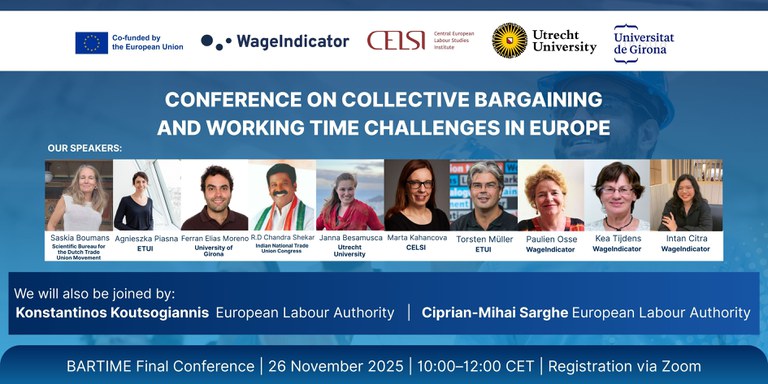
In light of the BARTIME research project, WageIndicator and its partners — the University of Utrecht, the Central European Labour Studies Institute (CELSI), and the University of Girona — held the closing conference on Collective Bargaining and Working Time Challenges in Europe.
Watch the Recording
Collective Bargaining and Working Time Challenges in Europe - AGENDA
| 10:00 - 10:10 | Opening - Paulien Osse, WageIndicator Foundation |
| 10:15 - 10:45 |
Panel: What’s going on with working time? Chair: Janna Besamusca, Universiteit Utrecht Speakers:
Presentation: Standard Working Hours Across Europe and Across Time - Kea Tijdens |
| 10:45 - 11:00 |
Showcase: BARTIME Working Time Tool Speakers:
Presentation: Time for Work, Time for Rest - Working Time Tool Try out the Working Time Tool |
| 11:00 - 11:15 |
Presentation: Overtime Work and Wage Adequacy Speaker:
Presentation: Overtime and Wage Adequacy in the European Union: Evidence from Survey Data and Collective Agreements |
| 11:15 - 11:30 |
Presentation: Promoting the declaration of overtime from the point of view of un(der)declared work Speakers:
Presentation: Declaration of overtime from the point of view of un(der)declared work |
| 11:30 -11:55 |
Panel: Shaping the Bargaining and Policy Agenda on Overtime Work Overtime - especially unpaid or under-declared overtime - remains widespread across Europe and is closely linked to avoiding full wage payments and social security contributions. At the same time, many workers rely on overtime for supplementary income, while employers often use it to maintain flexibility and competitiveness in globalised markets. In this context, where should policy and negotiation efforts be directed? Should the goal be to reduce overtime and prioritise compensation through time off, or should all overtime hours be accepted as part of work organisation but fully and transparently paid? Chair: Marta Kahancová, Central European Labour Studies Institute (CELSI) Speakers:
|
| 11:55 - 12:00 | Closing - Janna Besamusca, Universiteit Utrecht |