Life After Meta: What a New Survey Reveals About the Conditions of Data Workers in Kenya
During Meta's withdrawal from the country, WageIndicator and the Data Labelers Association conducted a survey examining the working conditions and pay of Kenyan workers in the global AI supply chain. What do the preliminary results tell us, and how are they interpreted by workers' representatives?
June 5 2026
Kenya's Data Workers: a Labour Hub in the Global AI Supply Chain
Edwin Mwaura lives in Kenya and has been working in data labelling for eight years. He has mainly been employed for BPOs, third-party providers that major tech companies, such as Meta and Google, use to outsource data-related tasks like photo tagging, text review, and video annotation. From self-driving cars and virtual assistants to content moderation, chatbots, and object recognition (even wondered how autonomous vacuum cleaners work?), these workers provide the necessary context and oversight for AI systems to function more securely and effectively.
Over the years, Kenya has emerged as a global hub for the human labour needed to develop and train artificial intelligence, and the space has become crowded quickly, with several BPOs like CloudFactory and platforms like Remotasks being active in the country. Thanks to good internet penetration and widespread English proficiency, so many people have entered this market that finding work has become increasingly difficult.
Despite everything, Edwin is now highly experienced, having been engaged in a variety of projects and developed a wide range of skills. Sadly, however, dark clouds can quickly gather, even for a highly skilled worker.

The Meta Case and the Hidden Data workers in Kenya
After Meta's termination of its contract with Sama, a Nairobi-based company to which Meta had outsourced content moderation and AI training work, and its subsequent withdrawal from the country, more than 1,000 Kenyan workers were suddenly made redundant. Although Edwin was not affected by the layoffs, he's not sure whether he'll still have a job in a month or two, and this is due to the nature of data work itself. 'Normal' companies do not recognise the value of his experience in photo tagging or prompting the large language models behind ChatGPT and Claude. His skills are not transferable to any other field, so after investing years in this sector, Edwin’s only options are jobs in data labelling and AI, and as things stand, he cannot predict what the future holds for him. There is no security, nowhere safe for him to save money or make plans.
Behind AI, a human cost - but does the world know?
As President of the Data Labelers Association in Kenya - 1,100 workers currently signed up - Joan Kinyua captures stories like Edwin’s all the time. When we contacted her and her team to design and distribute a joint survey exploring the working conditions of associates like Edwin, layoffs, and uncertainty caused by the Meta case were at their peak. Participation was voluntary, and the survey was anonymous, yet it was carried out at a time when workers were worried about losing their jobs.
The limitations were real, but so was the value of this initiative. Fully aware of the context and in agreement with Joan and Ephantus Kanyugi, the Vice President & Programs Lead of the association, we decided to go ahead and took every precaution to ensure respondents felt safe participating. The human cost of AI is rarely, if ever, captured in research, and a survey exploring pay, stress, and other working conditions among data workers in Kenya would have allowed us to examine these issues more closely and provide evidence-based insights for the sake of research and advocacy.
As Edwin, Joan and Ephantus themselves reiterated during the webinar co-organised with the Data Labelers Association, in which we presented the preliminary results, you can't address what you don't acknowledge. ‘These tech companies are providing us with work,’ Edwin stresses. ‘They need to find out exactly what the working conditions and pay are.’ Or as Joan explains, ‘People who work directly with Meta tend to be well paid, but wages are extremely low when work is outsourced, and companies and users need to be aware of this.’ 'When someone uses ChatGPT or any other tool, they don't realise that there's someone behind them,' adds Ephantus, stressing the importance of raising user awareness.
Over the past two years, the Data Labelers Association has generated a lot of buzz, and something has started to move: for new projects in CloudFactory, for instance, they are now offering 3- and 6-month contracts. Change won't happen overnight, but spreading the word, building knowledge, and making these workers visible is a good place to start.
What is AI really like for data workers in Kenya?
Joan Kinyua was a data labeller herself before becoming an advocate. She knows how the 'cycle' works: you have a job, usually more than one on different platforms, and you need to seek out tasks after completing your work to make ends meet. ‘You could sit at your laptop for hours, never knowing when a task will come through, but still having targets to meet. There is no time to develop skills or access the resources needed to go back to school. Younger people are usually comfortable with low pay because they are unaware of how much they should be earning. I also experienced low pay, but at least I was earning something.’
The initial results of the survey that we developed and distributed with the Data Labelers Association reflect what Joan, Ephantus and Edwin observe in practice, beginning with pay.
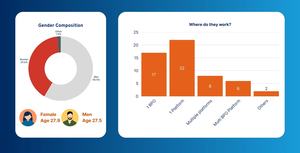
A total of 57 responses were completed. The gender breakdown was similar, with an average age of around 27 years for both men and women. Most of them had completed a bachelor's degree.
In terms of pay, 94% of women and 72% of men earn at least the Minimum Wage that relates to similar jobs, although their work does not fall under any minimum wage coverage. On average, female labelers earned Ksh 21,849.72 and male labelers earned Ksh 26,106.83 (around 200 dollars) in the month before the survey, not standardised for working hours, from their main platform/BPO. However, one should consider that self-employed data workers should actually receive a higher amount to cover their work-related costs and the cost of living, as these are their sole responsibility. When we looked more closely at the base pay or Living Tariff that data workers should actually receive to cover their living expenses, we found that only two in ten men were receiving it. A few male outliers who somehow managed to work very hard for very long hours and earn more. None of the women earned above Living Tariff. ‘One worker told us that they do three jobs but earn less than $300 per month,’ Ephantus shares. ‘It’s quite common: we were looking at a platform yesterday that said they would pay $0.3 for 1.000 tasks.’
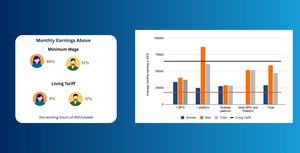
Most workers reported earning the legal minimum (earnings standardised for working hours), yet still being unable to cover costs (in line with the WageIndicator's Living Tariff concept)
As he explains: ‘When you talk about the Minimum Wage, you generally assume that you can make ends meet in Kenya on 200 dollars. But once you start adding costs, 200 dollars doesn't go very far. That's why I think the idea of a minimum Living Tariff is ingenious, because it incorporates the actual costs that are attached to this space into the minimum pay somebody should receive. Insurance, internet access, but also power and water, as you use your own space for work and living. At least then, after covering your costs, there is sufficient pay to get by or earn a decent income.’
‘Even in terms of gender pay gap, ‘you'd find yourself doing a very high-quality job,’ Joan adds, ‘and then when you look at what you've earned versus a male counterpart, you'd see a huge difference. But then there's nobody to question it.’
Another notable finding was that workers often end up working long hours, including unpaid activities, in order to find new tasks and maximise their income. The survey shows that those who work across multiple platforms work significantly more hours than the average 45-hour week. Some male workers reported working 229 hours in a month, and these are just the paid hours. 28% of men said they had been busy with liaising with potential clients, carrying out administrative tasks, and undergoing training. None of this is remunerated, and on average, women did 20 hours of unpaid work in a month. This result reflects what the Data Labelers Association hears from its members: ‘I’ve heard of people doing three jobs at the same time and being forced to work 20-hour days. They only leave their chairs to go to the toilet or get food,” shares Ephantus.
The health toll on Kenya's AI workers: when job insecurity hits hard
Aside from the poor and uncertain financial situation, long working hours inevitably take a toll on data workers’ physical and mental health.
‘Many of us are struggling with mental and physical exhaustion,' Edwin confirms sadly. ‘The problem is that we earn very little, so to make sense of it, you have to do a lot of work. Some people experience back pain because they sit in a chair for 16 or 18 hours a day, only sleeping for a few hours before getting up and starting work again.’
Six out of ten workers surveyed said that their work was mentally exhausting. The risk increased significantly at the age of 30, and was also associated with intense job insecurity.
The survey was conducted during a period of widespread job losses in Kenya. Unsurprisingly, nine out of ten respondents (both men and women) said they were concerned about their future. This figure rises to ten out of ten among those in their thirties and above, including people who were married and had families, as well as those who were the primary earners and had many responsibilities ahead of them. The high numbers could also be reflective of the layoffs that were happening around the time of the survey.
What’s next?
Due to the significant number of layoffs caused by Meta's withdrawal from the country, the situation has become critical. The association met with many workers who are now planning to move to other platforms or to return to their home countries and leave Nairobi altogether because they cannot support themselves. They are extremely vulnerable and often have no choice but to turn to substance abuse to cope. ‘We are looking for new organisations to set up after the summer and create jobs, but that's not the case yet,’ says Joan. ‘Workers have invested years of their lives in this field, taken difficult cognitive tests to access it, and become highly experienced. And now they don't know where to turn.'
‘As an association,’ Ephantus adds, ‘we are trying to organise programmes for workers. In a span of six months, we met and trained around 30,000 workers, just to give you an idea of the scale. We'll also continue to generate interest in this issue in order to hold companies accountable for the system that favours them.’
Edwin and thousands of other data workers like him in Kenya have invested years of their lives in this indispensable yet overlooked work. Now they are asking for this 'space' to improve and for their contribution to be recognised. Companies (and users) often forget that without them, the AI tools we use every day won’t function. Millions of workers like Edwin around the world make artificial intelligence less ‘artificial’ than one might think.