Platform Commission Caps Are Not Enough: Lessons from Indonesia's Ride-Hailing Regulation
President Prabowo Subianto issued Presidential Regulation No. 27 of 2026, reducing the platform commission rate from 20 to 8 percent. However, the regulation fails to address two key issues: algorithm transparency and the mechanism for setting shared rates.
4 June 2026
Wuri has been working as a ride-hailing driver for nine years. With two children to support, she has little choice but to ferry passengers and deliver goods through the app every day. She is on-bid, actively available for orders, for 10 to 12 hours a day, and not infrequently works past midnight.
Her daily income is anything but predictable, ranging from IDR 70,000 to IDR 200,000. And that is before costs. A survey by the Institute for Demographic and Affluence Studies (IDEAS) in December 2025 found that the average gross daily income of ride-hailing drivers stands at IDR 126,313 or about $7.10.
Wuri is one of hundreds of thousands of ojol drivers, the Indonesian term for motorcycle ride-hailing workers, navigating the same grind every day. Indonesia has one of the largest gig workforces in the world, and what plays out here, in platform fees, algorithmic control, and driver earnings, matters well beyond its borders. When a government the size of Indonesia moves to regulate platform commissions (a fee that platform charges to drivers)_, it becomes a test case for gig workers everywhere.
That pressure has been building for years. Between March 2020 and March 2022 alone, platform drivers staged 71 collective actions involving 132,000 workers. Research by Arief Novianto found that eight of those actions specifically targeted platform commission cuts.
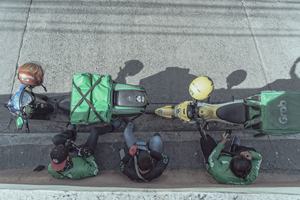
Not A Choice, But Pushed by the System
To understand how the commission system works in practice, take Bunga (anonymous). After joining a May Day rally in Yogyakarta this year, she went back to work. At 11:47 PM, she checked the detailed breakdown for a completed trip. The passenger paid IDR 24,000. The app showed:
- Trip fare (80% for Driver): IDR 19,500 ($1.10)
- Insurance fee: IDR 1,000 ($0.06)
- App service fee: IDR 3,500 ($0.20)
- Bunga's total earnings (80% of trip fare): IDR 15,600 ($0.88)
That is how a standard trip works. But the picture changes when drivers use the platform's subscription feature. Programs like GoRide Hemat charge drivers IDR 2,500 to IDR 12,500 (roughly $0.14–$0.70) for a bundle of two to nine or more orders. When the feature was launched in late 2025, it cost just IDR 100 (less than one US cent).
Officially, participation is optional and the platform commission will be none . In practice, drivers who opt out find their accounts go anyep, a term drivers use to describe a sudden and sharp drop in incoming orders directly cutting their earnings.
"If we join the subscription program, we pay IDR 13,000 (about $0.73) for seven trips. Gojek charges IDR 12,500, Grab charges IDR 13,000," Wuri explains.
Wuri and her driver community, Wakanda, have refused to use the feature. They believe it enables low fares and poor working conditions. The cost is real: drastically reduced income. To compensate, they have shifted to parcel delivery though the rates tend to be even lower.
Still, Wuri acknowledges that not every driver has the same ability to resist. "It's not really a choice. The algorithm system basically forces you into it," she says.
Beyond the subscription scheme, platform tier systems add another layer of pressure. Drivers are ranked based on their performance: completed orders, equipment compliance (jackets and helmets purchased at their own expense), and sustained ratings. Reaching "priority account" status demands more time and more personal expenditure, and often with no guarantee of proportional reward.
92% on Paper
On International Workers' Day 2026, speaking to thousands of workers and drivers gathered for the rally, President Prabowo Subianto announced a new policy.
"How much should the ojol cut be? 20%? 15%? 10%? You want 10%? I'm telling you right now — I don't agree with 10%. It has to be below 10%," he declared.
The result was Presidential Regulation No. 27 of 2026 on the Protection of Online Transportation Workers, which caps the platform commission at 8%. Platform companies have since issued official statements committing to comply and have scrapped the paid subscription system alongside it. Before this regulation, the commission cap was set at 20% under the Ministry of Transportation's Decree KP 1001 of 2022.
On paper, the change looks significant. Drivers now retain 92% of the fare which is a substantial share. But numbers on paper do not always translate into decent income.
IDEAS research calculated that under the 20% commission, after deducting daily operational costs (fuel, food and water, mobile data, oil, and vehicle maintenance) averaging IDR 65,694 ($3.70) per day, drivers were left with a net income of around IDR 60,619 ($3.40) per day, or IDR 1.51 million ($85) per month.
Simulations by IDEAS researcher Anwar project that reducing the commission to 10% or 8% would raise net income by 26–31%, bringing it to approximately IDR 1.91–1.99 million ($108–$112) per month. Yet compared with Indonesia's average 2026 minimum provincial wage (UMP) of IDR 3.3 million ($186), that figure is still only about 60%.
The industry has not welcomed the change without resistance. "Most companies in this industry cannot survive these changes," an industry representative told Reuters in January 2026. And there are concerns that platforms may respond by raising fares for passengers though a 2025 Policy Research Center survey found that 75.2% of respondents said they would be willing to pay more if it meant drivers received fair income. More than 80% criticised the commission system and additional fees, and supported regulation and decent work for drivers.

Who Controls the Calculator?
The 8% cap addresses one piece of the puzzle. But Indonesia's online transport platforms were not built on a fixed-price model. Like Uber they operate on dynamic pricing: fares calculated in real time based on supply and demand.
Gojek describes its dynamic pricing as a system that balances supply and demand to reflect local conditions. The platform argues this leads to shorter waiting time and better earnings aligned with demand.
A major study from the University of Oxford tells a different story. Analysing 258 Uber drivers in the United Kingdom across 1.5 million trips between 2016 and 2024, the researchers found that dynamic pricing led to higher fares for passengers, and yet lower earnings for drivers. Since the system was introduced in 2023, inflation-adjusted hourly earnings fell from €22 to €19. Waiting times also increased, contrary to the platform's claims.The experience of UK platform workers is also explored in WageIndicator's Gig Work Podcast, featuring British former Uber driver and tech expert James Farrar, who has fought for transparency and fairness in the platform economy.
Researcher Suci Yuana Lestari from Universitas Gadjah Mada warns this dynamic could play out in Indonesia too. "In my view, there could well be a reduction in earnings if the regulation, the Presidential Decree, does not also constrain the dynamic pricing system," said Yuana who was previous guest in our podcast to WageIndicator.
Open the Black Box First
"Right now, the only party that can set fares is the platform operator. The government doesn't receive the data. Workers certainly don't," Yuana says.
How platform algorithms actually work has never been made transparent. Drivers have adapted by sharing experiences informally: learning which times of day bring more orders, which locations attract passengers, and how long to stay on-bid. They piece together patterns from observation alone. Nobody really knows.
Algorithmic transparency would allow all parties such as government, platforms, and workers to see clearly allocation of work & deactivation, and how fares, commissions, and earnings are calculated. The current situation is like cutting a cake: drivers now receive a bigger slice at 92%. But the platform alone decides how large the cake is in the first place. Workers and the government have no seat at that table.
Yuana sees this as the core issue. "We need a mechanism where workers' perspectives feed into how the fare calculator is built. A genuine Living Tariff - a concept developed by WageIndicator understanding Living Wages for platform workers and freelancers - , in my view, depends on exactly this: a tripartite mechanism to determine a living tariff that workers can actually refer to."
What Comes Next
As long as algorithms remain black boxes and fare-setting remains a unilateral decision by platform operators, the 8% cap is a step forward, but not the finish line. Transparency comes first. A Living Tariff follows.
For drivers trying to understand what they should actually be earning, accounting for fuel, waiting time, social security, and every other cost platforms do not cover, tools like WageIndicator's Living Tariff Tool offer a starting point. But the deeper need is structural: a tripartite mechanism where workers, government, and platforms determine fares together, with open data on the table.
Sources:
Muhammad Anwar (20 May 2026), "Menakar Dampak Perpres Ojol terhadap Kesejahteraan Pengemudi", Majalah Sedane.
Stefanno Sulaiman (14 January 2026), "Exclusive: Indonesian ride-hailing industry set for shake-up under draft presidential decree", Reuters.
Arif Novianto, Anidya D. Wulansari, Rizky Ardinanta (January 2025), "Menurunkan Potongan, Meningkatkan Keadilan: Mendorong Regulasi Platform Transportasi Online yang Berpihak pada Pengemudi dan Konsumen", Policy Research Center.
Gojek, "Dynamic pricing for transport services", gojek.com.
Zhaki Abdullah (31 December 2018), "Gojek introduces dynamic pricing", The Straits Times.
Reuben Binns et al. (June 2025), "Not Even Nice Work If You Can Get It: A Longitudinal Study of Uber's Algorithmic Pay and Pricing", FAccT: The 2025 ACM Conference on Fairness, Accountability and Transparency.
Note:
The exchange rate used in this text is 26 May 2026: IDR 17,750 per USD.