


Gender Segregation In The Workplace Jobs For Men, Jobs For Women - But Change Is On Its Way
Jobs for women, jobs for men - is occupational segregation really still the case? We speak to WageIndicator Foundation researcher Kea Tijdens and look at the data, to see how much has changed. And how much hasn't.

21 April 2026
*Glenda works at a tech start-up in Cape Town. She’s proud that 50% of the company consists of women (in fact, it’s one of the reasons she applied for her job.) But yesterday, while sitting in the staff canteen, she looked around at her colleagues. Rosy, Diya, Siphokazi and Rozena are in the marketing, customer support and admin departments. Glenda, herself, is in HR. Dan, Fikile, Sammo and Brent are in data analysis and software engineering. Glenda knows that technical positions generally pay more, and offer good promotion possibilities. But why, she wonders, are there mainly men in these positions?
“Because, despite the influx of women into the workplace, occupational segregation still exists,” says Dr Kea Tijdens, researcher at the WageIndicator Foundation. “Yes, there have been changes over time, but the terms ‘jobs for men’ and “jobs for women’ still unofficially apply.”
Job equality not covered by law
Dr Tijdens points out that while equal pay policy - no payment discrimination allowed when men and women do the same job - is generally regulated in labour laws around the globe, equal job policy is not. “One finds that women overwhelmingly dominate care jobs, and men tech or industry-related jobs. The latter sector is paid better than the other - so on average women still earn less,” she says.
Care jobs include employment in the health, education and hospitality sectors, while tech or industry jobs include employment in the IT, transport and construction sectors. The actual occupational structure is also gendered: according to a recent Eurofound article on gender segregation in Europe, more women work in clerical, service, and sales roles. More men work mechanics, and as plant and machine operators.
What is startling is how deeply this divide is built into the structure of labour markets.
- The latest data from the 2021 European Working Conditions Telephone Survey (EWCTS) shows that more than half of workers in the EU are still in jobs dominated by their own gender.
- The WageIndicator DecentWorkCheck (DWC) data collected in garment factories in Ethiopia between 2018/19 and 2024/2025 show men are far more likely to be mechanics and production managers, and women to be sewing machine operators and tailors
- WageIndicator DWC data in Indonesia collected between 2023 and 2025 shows women dominating as quality checkers while men are mechanics.
- In Bangladesh garment factories, WageIndicator DecentWorkCheck (DWC) data shows that of female workers interviewed, 4% held higher-level positions in 2024, compared to 19.66% of male workers. In 2026, 3.05% of female workers held a higher-level position, compared to 13.54% of male workers.
Shifts in gender segregation: more women in the workforce
However, there have been some positive changes. “This is particularly due to the influx of women into the labour market. Some occupations in particular have more women entering, which can potentially change the male-female ratio,” says Dr Tijdens. “The legal sector, for example, is increasingly entered by women, as is the medical sector. Both used to be very male dominated, but that has shifted.”
Overall, more women have joined the workforce. According to ILO Global Working Trends 2024, the total number of working women has grown from roughly 1 billion in 1993 to over 1.2 billion in the early 2000s. The share of women with work in total employment has risen in the past ten years to just over 40%. This does, however, differ by region, with the Middle East, North Africa, and South Asia demonstrating much lower participation rates. The sheer increase of women in the workforce does not guarantee better paid jobs for women - but it definitely paves the way in certain areas.
New opportunities for women in the job market
“Some leadership roles within occupations are changing,” says Dr Tijdens. “Management roles are becoming more feminised, including CEOs of large companies. It’s important to remember, however, that we need to see consistent change happening over decades, rather than years, in order to mark it as significant change. For example, during World War II many women took on masculinised roles due to necessity, working in factories, driving trucks etc. As soon as the war was over, however, patterns returned to what they were.”
WageIndicator data shows change in more traditional working spaces as well, such as factories. “In the past, a typical factory could have 100 women workers and one male manager. We are seeing the amount of women in managerial and admin positions grow. So in ten years’ time we may see entire women-dominated factories with no men,” smiles Dr Tijdens.
- In the Flower sector in Ethiopia, WageIndicator DecentWorkCheck (DWC) data collected between 2018 and 2025 shows an increase in administrative (from 4% to 6%) and supervisory (0% to 7%) roles, with the proportion of male workers in higher-level roles decreasing (falling from 14% to 8% in administrative roles, for example).
“Due to the fact that women are generally better educated now, it opens up new opportunities for more women entering the labour market, particularly after giving childbirth. Such a phenomenon is changing occupational job segregation,” says Dr Tijdens.
Work life balance and gender segregation: Women still do more housework
It must be noted that work life balance continues to be gender-skewed, with women still taking a major role in domestic housework and child rearing. Women work longer and earn just a third - 32% - of what men get per hour, when paid and unpaid labour, such as domestic work, are taken into account, according to the 2025 World Inequality Report.
“Women typically work a couple of hours less than men, to have time for housework. Housework is still a huge problem - equal sharing hardly occurs. The burden is still on the woman,” says Dr Tijdens. “You can reduce the hours in some way, like having shopping delivered, but women still do the majority. Thus they have fewer leisure hours compared to men.”
It’s one of the reasons why many women prefer to work from home, if given the option, so that they can balance domestic chores more easily. Meanwhile, research has shown that men don’t spend much time on housework, even when it is their responsibility.
“Men are more often inclined to outsource housework. They will hire a cleaning person instead of doing the job themselves. The higher their earnings, the more they can reduce their housework load by hiring cleaning ladies, for example,” says Dr Tijdens.
Gender segregation and bias in AI
With new job opportunities also come new challenges. AI has a particular gender-based bias that directly affects women - often young women from financially-disadvantaged areas. In India, for example, young women in rural areas work as content moderators for global tech countries, helping to capture and flag specific images and text that frame machine learning. With AI increasingly only as good as the data it is trained on, these “ghost workers” are a vital part of the chain, according to a recent Guardian article.
Around 80% of data-annotation and content moderation workers come from rural, semi-rural, or marginalised communities. Companies often set up in smaller towns where costs are lower and there are more first-generation graduates looking for work. Women make up half or more of this workforce. They work long hours for little pay, and have few protections.
“In our research, what I have noticed is that AI developers and statisticians are predominantly male. There are few women in that area,” says Dr Tijdens.
How can gender segregation in the workplace be improved?
“From an HR perspective, companies with recruitment procedures that offer women-friendly policies (for example good maternity leave) are obviously more likely to attract more women to certain positions. On the other side, companies not offering this - for example no maternity leave - are unlikely to change their employment profile in favour of women,” says Dr Tijdens.
Politics and policies are also a part of this. “Political change can affect a woman’s career prospects. You can see this, right now, in Afghanistan,” she continues. “Conservative values and policies can further establish occupational segregation.”
On the other hand, a progressive approach to recruitment and promotion can make all the difference.
Conclusion
*Glenda, who has only recently noticed that there is a substantial divide in her workplace, needs to make sure the tech start-up she works for starts making a difference in their hiring policies - before that 50% staff quotient they boast of becomes meaningless.
Gender inequality remains “a defining and persistent feature of the global economy”, as highlighted in the 2025 World Inequality Report. Occupational segregation is a part of this. Women and men continue to be channelled into different roles, often reinforcing disparities in pay, security, and opportunity.
While some sectors are beginning to shift, progress is uneven. Without strong, coordinated action - from employers, labour institutions, and governments, these patterns will not simply fade with time. They are structured into how work is organised. Real change requires deliberate policies that do more than open doors, or pay lip service to stats; they must actively reshape the systems that keep them closed.
References:
Gender and Jobs in Ethiopia’s Flower & Garment Industry: DecentWorkCheck Insights
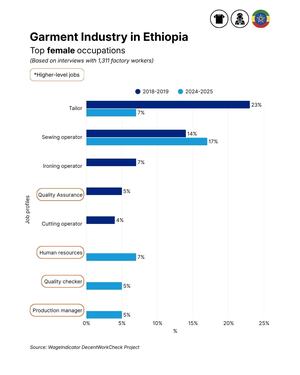
The percentage of women in higher-level roles increased from 5% in 2018-19 to 17% in 2024-25.
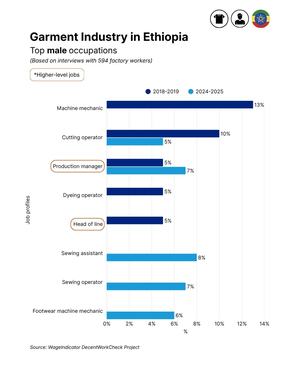
The proportion of male workers in higher-level roles decreased from 10% in 2018–19 to 7% in 2024–25.
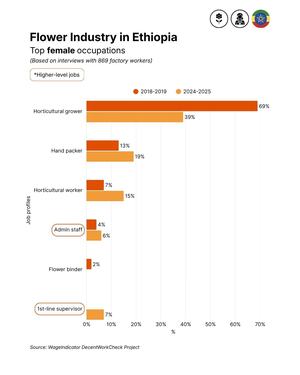
In addition to a 2% increase in female administrative roles between 2018 and 2025, it was found that women accounted for 7% of first-line supervisory roles in horticulture.
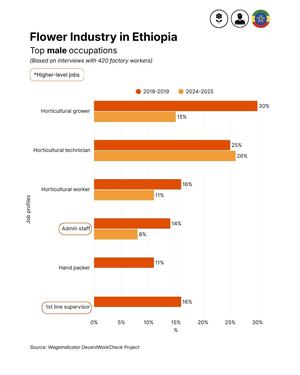
The proportion of men in senior administrative roles fell from 14% in 2018–19 to 8% in 2024–25.
Authors

Karen Rutter

